
October 18, 2026
Exhibitions
Exhibitions

From a £5 million Brueghel and three major Alice Neel sales to George Rickey, global modernism and a £675,000 Triceratops skull, Frieze Masters rewarded collectors who looked beyond categories.
A nearly ten-foot John McCracken column in the living room, Scott Burton chairs in the kitchen and Sturtevant beside the bed: Patrick Collins’s homes show what happens when a collector lets difficult art remain difficult.
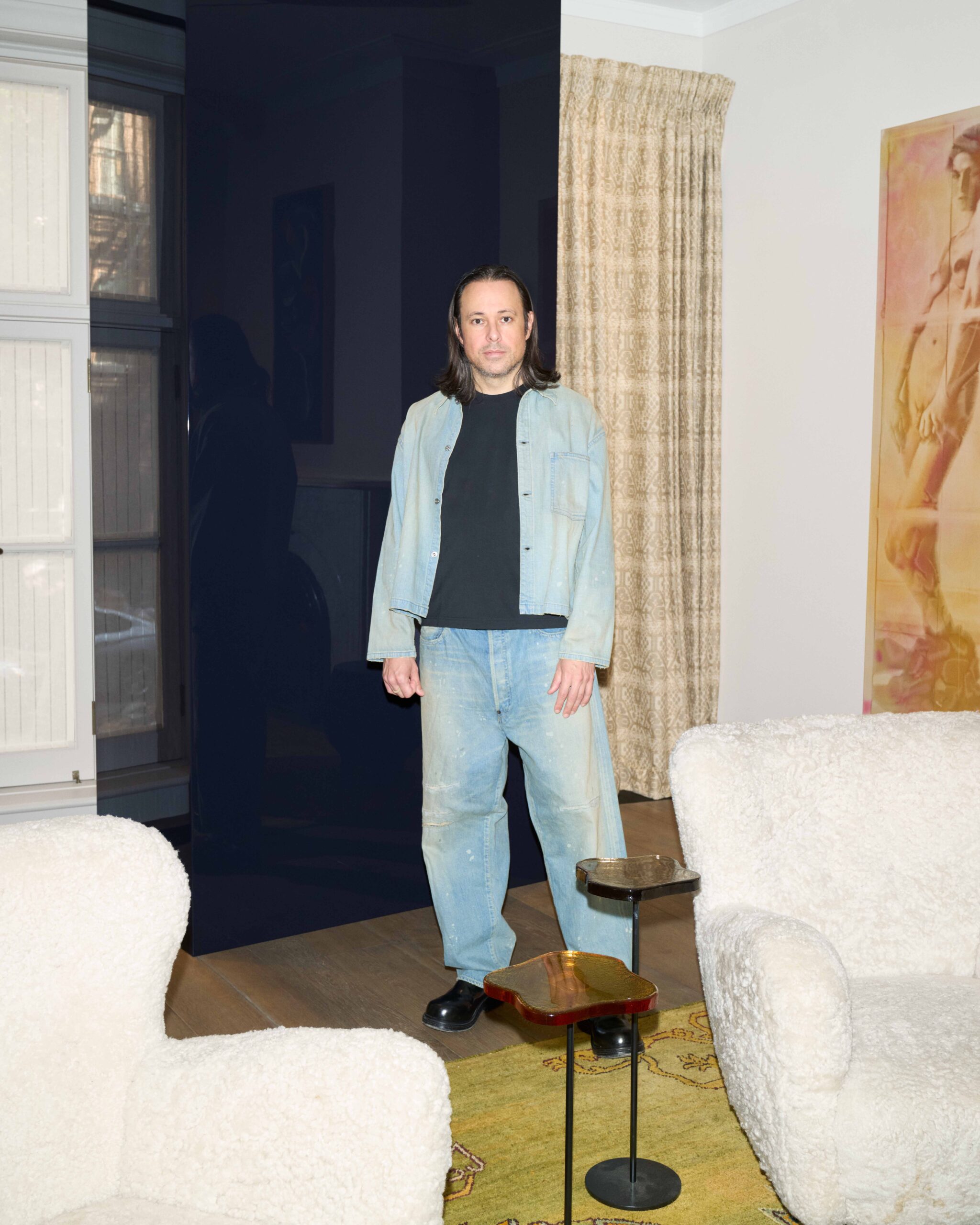
There is a temptation, when art enters a home, to domesticate it. A painting is centred over the sofa. Sculpture occupies the empty corner. Colours echo upholstery. The collection and the interior are encouraged to behave politely around one another.
Patrick Collins collects differently.
In his New York living room, John McCracken’s Untitled, Black Column, 1977, rises to almost ten feet. Collins describes the work as deep purple — so dark that it initially appears black — and so large that visitors can paradoxically overlook it before suddenly registering its presence. A pair of Scott Burton marble ziggurat chairs once sat in his kitchen, leaving guests uncertain whether they were looking at sculpture or furniture. Beside Collins’s bed hangs an image that appears, at first, to be a small Andy Warhol flower print. It is Sturtevant.
This is not art selected to complete rooms. The rooms have learned to accommodate ideas.
Collins’s interest in difficult art is not a recent response to the market’s renewed enthusiasm for conceptual practices. In a 2012 interview with D Magazine, he recalled writing about Dada in high school, studying art history at Columbia — including a class with Rosalind Krauss — and calling Deitch Projects in his mid-twenties to buy a painting.
That history gives useful context to the collection he now divides between Dallas and New York. The current emphasis on historically significant conceptual and sculptural work is not a stylistic pivot imposed by an adviser or a fashionable checklist. It grows out of a longstanding attraction to works that are intellectually demanding, materially ambiguous or difficult to place.
That kind of collecting produces a very particular kind of home.
McCracken’s column is a perfect example. His polished plank and column sculptures occupy an unstable territory between painting, sculpture and architecture. In a museum, the visitor arrives already knowing that the object has institutional status. In a domestic living room, that certainty disappears.
Collins’s work is almost ten feet tall, with a base he gives as 48 by 29 inches. Its colour is dark enough to read as black. It can seem architectural — part monolith, part vertical interruption — before the eye isolates it as an artwork.
That delayed recognition is something a home can produce better than a white cube. Domestic space strips away some of the cues that tell viewers how to behave. The visitor has to discover the work rather than approach it under a label.
Scott Burton built much of his practice around precisely this instability. His furniture-like sculptures challenge the supposedly clean boundary between aesthetic object and useful object.
Collins once placed a pair of Burton marble ziggurat chairs in his kitchen. Guests repeatedly wondered whether they were permitted to sit on them. Collins points out that, in terms of Burton’s intention, they are both art and furniture at the same time.
Moving the chairs into a protected museum display can explain that proposition. Putting them in a kitchen makes the proposition real.
This is one of the advantages of a serious collector’s home. Art is allowed to collide with routine. Furniture can become sculpture; sculpture can obstruct circulation; a work can be encountered while someone is looking for a glass rather than while following an exhibition route.
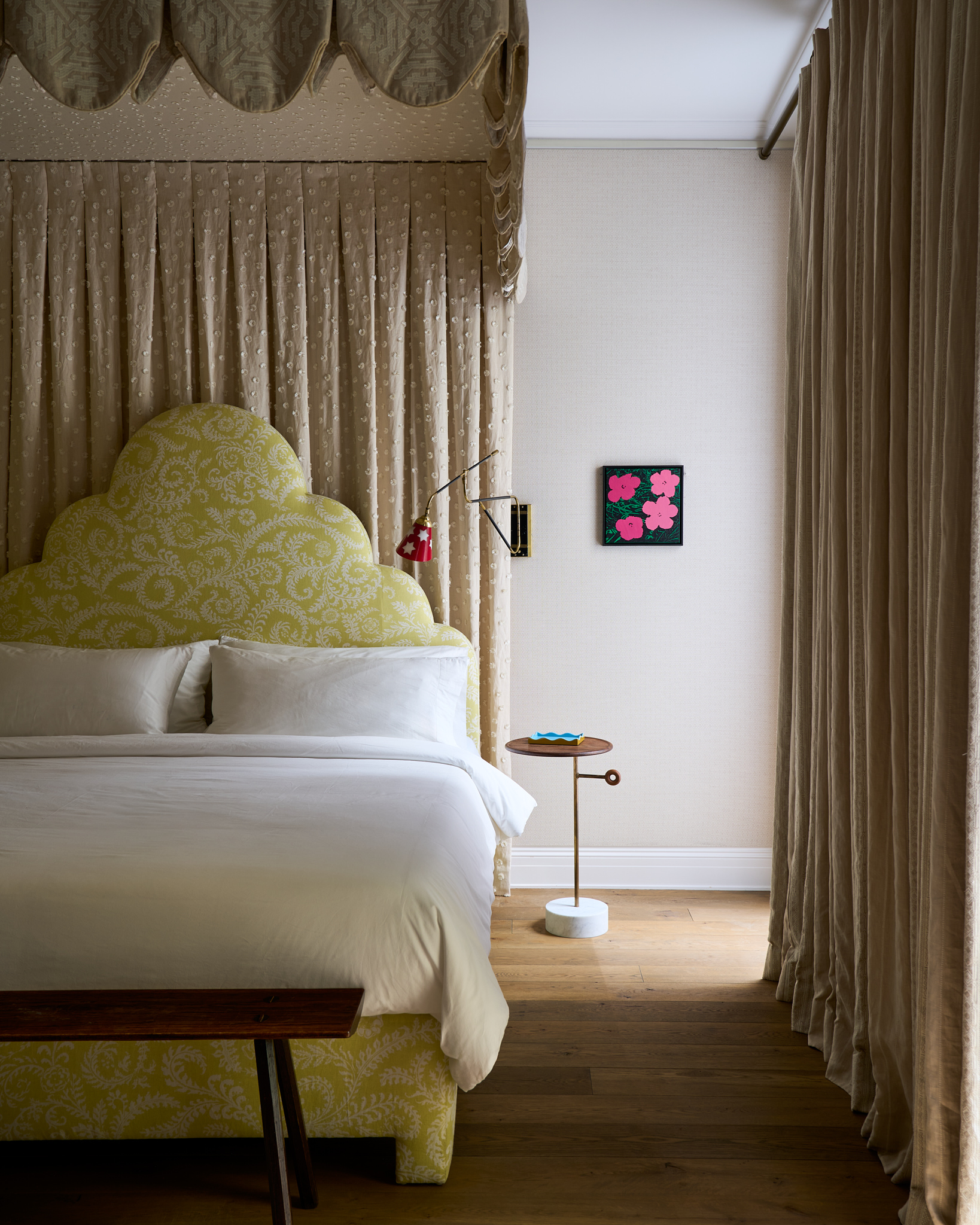
The bedroom offers an even more intimate example. The work beside Collins’s bed is Elaine Sturtevant’s Warhol Flowers (pink flowers), 1969–70.
Sturtevant’s practice of repeating the works of other artists — often close to the moment those originals were being made — turned apparent copying into a sophisticated investigation of authorship, repetition, originality and cultural recognition. The visual pleasure of the flowers is immediate; the conceptual problem they pose is not.
Collins has said that friends who understand his collecting know almost immediately that the image is Sturtevant because owning that particular kind of Warhol would be out of character for him. He likes that the work provokes questions.
It is a small but telling example of what connoisseurship looks like inside a home. The work functions simultaneously as image, intellectual trap and private joke.
Collins’s approach becomes still clearer in the story of his Yoko Ono Sky TV. He describes it as one of the most difficult acquisitions in his collection. According to Collins, most or all editions are held by major museums. To acquire one privately, he had substantial discussions with Ono and her studio, explaining how he collects and what he intended for the work.
Only then, he says, was he permitted to acquire an edition.
He later added other Ono works, consistent with a preference he states explicitly: collecting artists in depth rather than accumulating one recognisable example of each name.
That distinction matters. Checklist collecting tends to produce breadth and instant legibility. Depth produces relationships — between early and late works, between famous and obscure experiments, between the decisions an artist made over time.
It can also change access. At the upper end of the primary and private markets, the seller may care about the future of a work as much as the buyer cares about acquiring it.
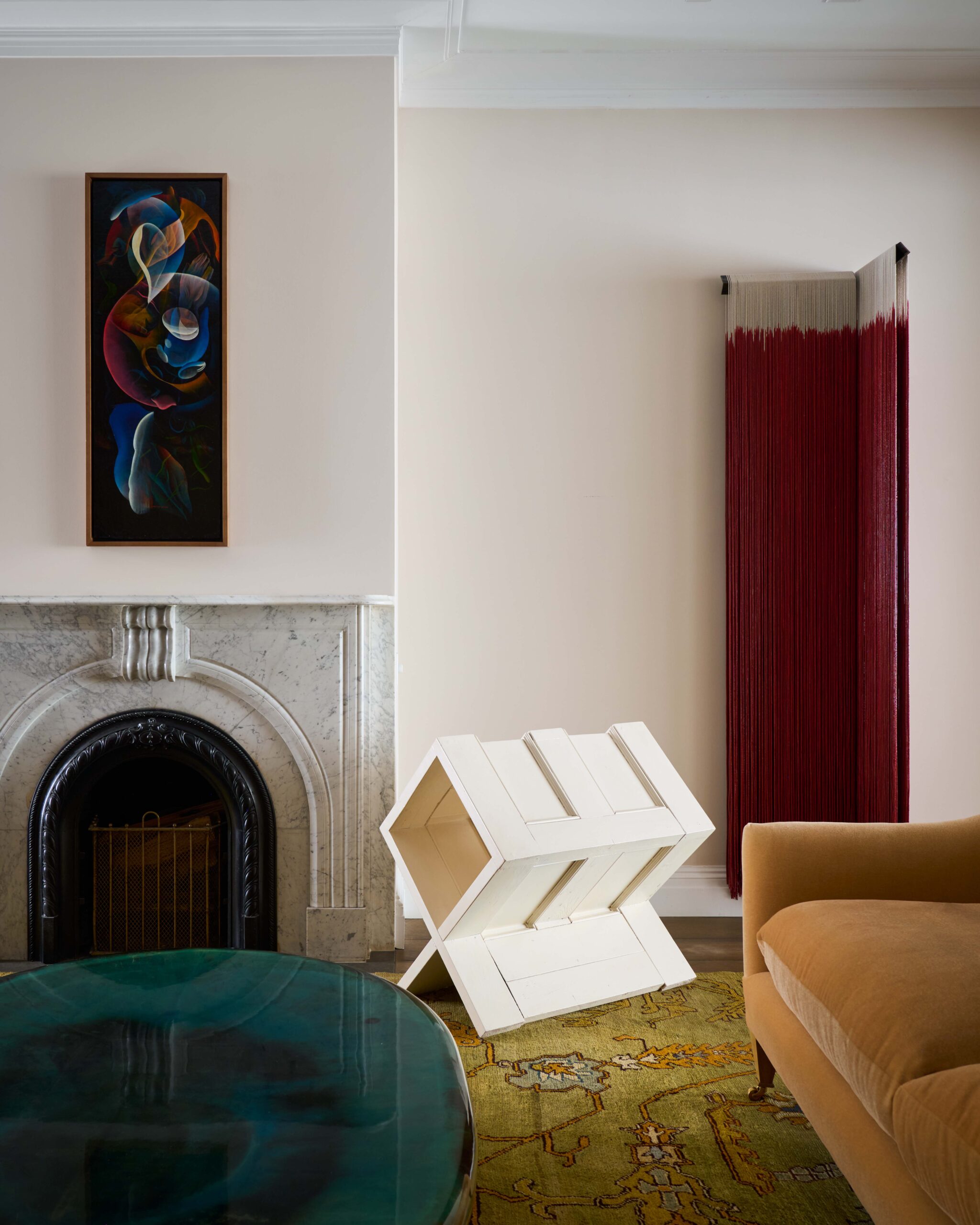
Another photographed grouping in Collins’s home places Paulina Peavy’s Untitled from the 1930s beside Robert Gober’s Untitled, 1988, and Delcy Morelos’s Organized Salt Water (agua salada organizada), 2014.
The combination is more revealing than a single trophy shot. Works from different generations and practices share a domestic field and begin to create arguments that would not necessarily appear in a museum chronology.
This is where collector homes can become genuinely interesting editorial subjects. The question is not simply what someone owns. It is what happens when works acquired at different moments are forced to coexist for years.
A private collection is a continuously changing exhibition. The curator happens to live inside it.
Collins is also unusually candid about the less glamorous part of the process. Asked about his most memorable rookie mistake, he cited buying too quickly. Early in his collecting life, established galleries did not necessarily know who he was or understand his intentions, and the works he was offered were not always the works he most wanted.
His retrospective advice is simple: he could have been more patient and spent more time talking with gallerists before buying.
That observation is more useful than most collecting maxims because it addresses the pressure that surrounds access. A new collector can mistake availability for opportunity. A work being offered does not make it the right work.
Collins’s own history makes the lesson credible. His interest in art extends back decades; the collection has had time to change through looking, education, relationships and restraint.
The most memorable art-filled homes rarely resemble galleries, and they should not resemble interior-design showrooms either. They reveal the habits and convictions of the person living there.
A Sturtevant beside the bed tells us something. So does a nearly ten-foot McCracken that can initially disappear into a living room. So do Burton chairs in a kitchen.
The works are not trophies positioned around domestic life; they are participants in it. They generate awkwardness, conversation, humour and occasionally inconvenience.
That may be the distinction between owning art and living with it. A great collector’s home does not make every difficult work comfortable. Sometimes it gives the work enough time and space to remain difficult.
Collector: Patrick Collins
Based: Dallas and New York
Early formation: Dada, art-history study at Columbia and an early purchase from Deitch Projects in his mid-twenties
Artists discussed: John McCracken, Scott Burton, Sturtevant, Yoko Ono, Robert Gober, Paulina Peavy and Delcy Morelos
Collecting approach: Conceptually challenging work; collecting artists in depth; long-term dialogue with galleries, artists and studios
Interior lesson: The strongest collector homes do not require every artwork to solve a decorating problem.
From a £5 million Brueghel and three major Alice Neel sales to George Rickey, global modernism and a £675,000 Triceratops skull, Frieze Masters rewarded collectors who looked beyond categories.

Frieze London closed with sold-out emerging booths, meaningful institutional acquisitions and selective blue-chip buying. The real story was not a boom, but a market rewarding specificity.

Nearly 150 works from RM’s collection meet SFMOMA in a major exhibition of Korean modern and contemporary art. Its real lesson is how a private collection develops a coherent eye.