
October 18, 2026
Exhibitions
Exhibitions

From a £5 million Brueghel and three major Alice Neel sales to George Rickey, global modernism and a £675,000 Triceratops skull, Frieze Masters rewarded collectors who looked beyond categories.
Peggy Cooper Cafritz lost more than 300 works in a devastating 2009 fire. The collection she built afterwards reveals why her legacy was never simply about ownership.
On the night Peggy Cooper Cafritz lost much of her art collection, the fire did more than destroy objects. It erased a domestic archive built across decades: works acquired before reputations had settled, pieces attached to friendships and arguments, and the visual record of a Washington life in which artists, students, politics and patronage repeatedly occupied the same rooms. More than 300 works were destroyed in the 2009 blaze that gutted her home, according to later reporting by The Washington Post. For a collector whose holdings were widely regarded as one of the country's most important private concentrations of work by artists of African descent, the loss was staggering.
The remarkable part of the story is not that Cafritz rebuilt. It is what the rebuilding revealed. She did not attempt to reconstruct the old collection work by work, as though replacing a destroyed inventory. She resumed the activity that had made the collection important in the first place: finding artists, living with their work, backing careers and treating collecting as one part of a much wider commitment to cultural life.
That distinction now sits at the centre of Dreams of This Future: The Collection of Peggy Cooper Cafritz, which opened at the Studio Museum in Harlem on 19 August. The exhibition draws from the more than 400 objects Cafritz left to the museum in 2018 and places her holdings back into the institutional ecosystem she had supported for years. It is an exhibition about art, certainly. It is also an unusually clear case study in how a collector's values can survive the collection's private setting.
Cafritz's collecting cannot be understood as a hobby that later evolved into philanthropy. The order was almost the reverse. In 1974, she co-founded the Duke Ellington School of the Arts in Washington, D.C., a public high school created to give serious arts training to young people in the city. Education, access and the development of artistic careers were therefore part of her cultural life long before her collection acquired its later scale.
That history changed the way she bought art. Cafritz was drawn repeatedly to artists at moments when a purchase, introduction or invitation could have practical consequences. Some of the names in her collection now occupy major museums, blue-chip galleries and art-market histories: Nina Chanel Abney, Sanford Biggers, Nick Cave, Noah Davis, Derek Fordjour, Titus Kaphar, Deana Lawson, Simone Leigh, Kerry James Marshall, Wangechi Mutu, Toyin Ojih Odutola, Jennifer Packer, Deborah Roberts and Tschabalala Self are among the artists represented in the Studio Museum exhibition. Read from the vantage point of 2026, the list can look uncannily prescient. That is precisely why the chronology matters. A collector's conviction is easiest to admire after the market and museums have agreed with it.
The more revealing question is what the collector did before consensus arrived. Cafritz's home was known not simply as a place where art hung but as a social space in which artists, curators, students and cultural figures met. The collection belonged to a network of relationships. Patronage was not outsourced to a foundation once a year; it was incorporated into daily life.
Collectors insure objects because fire, water, theft and accident are real. Yet the Cafritz fire exposes the limits of thinking about a collection solely in terms of replacement value. Insurance can establish a financial claim. It cannot recreate the moment an artist's work was first encountered, restore a work that was unique, or reproduce the exact constellation of objects that accumulated around a life.
That is why the decision to collect again matters. Cafritz returned to a market that had changed and to artists whose careers had moved. She also encountered a new generation. The second collection was therefore not a replica of the first; it was an extension of the same philosophy under different conditions. The fire broke continuity at the level of objects but not at the level of purpose.
There is a tendency to romanticise this kind of resilience, and that would miss something essential. Rebuilding a serious collection requires administration as much as emotion: insurance claims, records, provenance, conservation, new budgets, new decisions about where and how to live with art. The catastrophe made visible the infrastructure behind collecting. It also sharpened the question every collector eventually faces: if the objects disappear, what remains of the collection's identity?
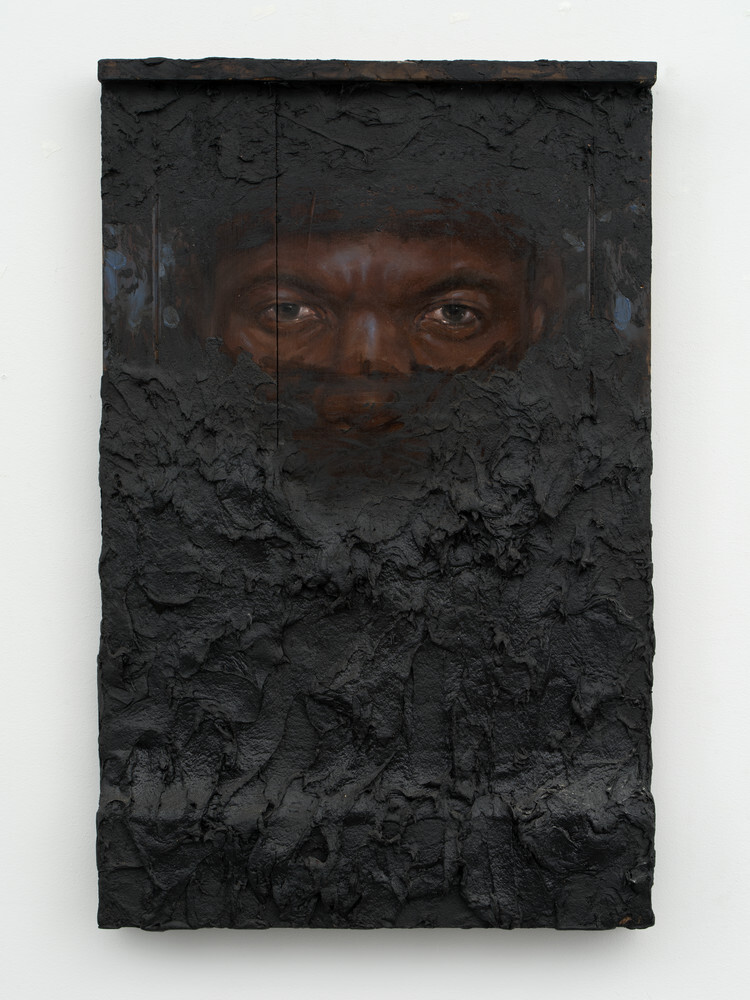
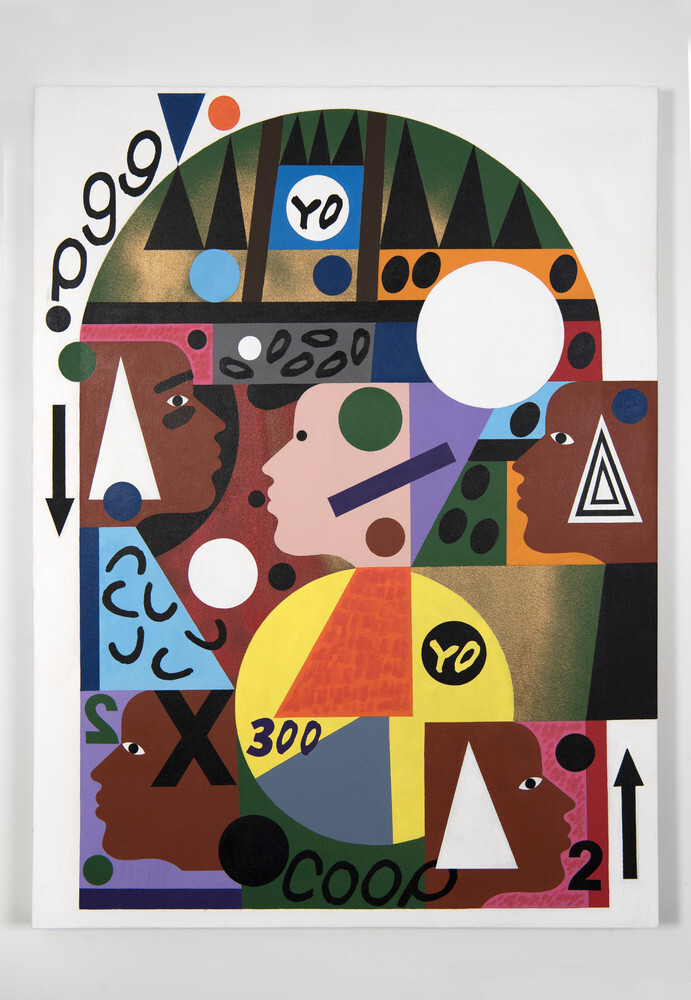
The works now on view in Harlem answer that question in material form. Titus Kaphar's Excavation (The Invisible Man) (2013) uses oil and tar on an antique and found panel so that a face appears to press through, and be swallowed by, a blackened surface. Nina Chanel Abney's Untitled (2012) compresses figures, symbols, numbers and graphic forms into a bright visual syntax. Nick Cave's 2009 Soundsuit, another Cafritz bequest, transforms found and crafted materials into a body-sized apparatus in which costume, sculpture, protection and performance converge.
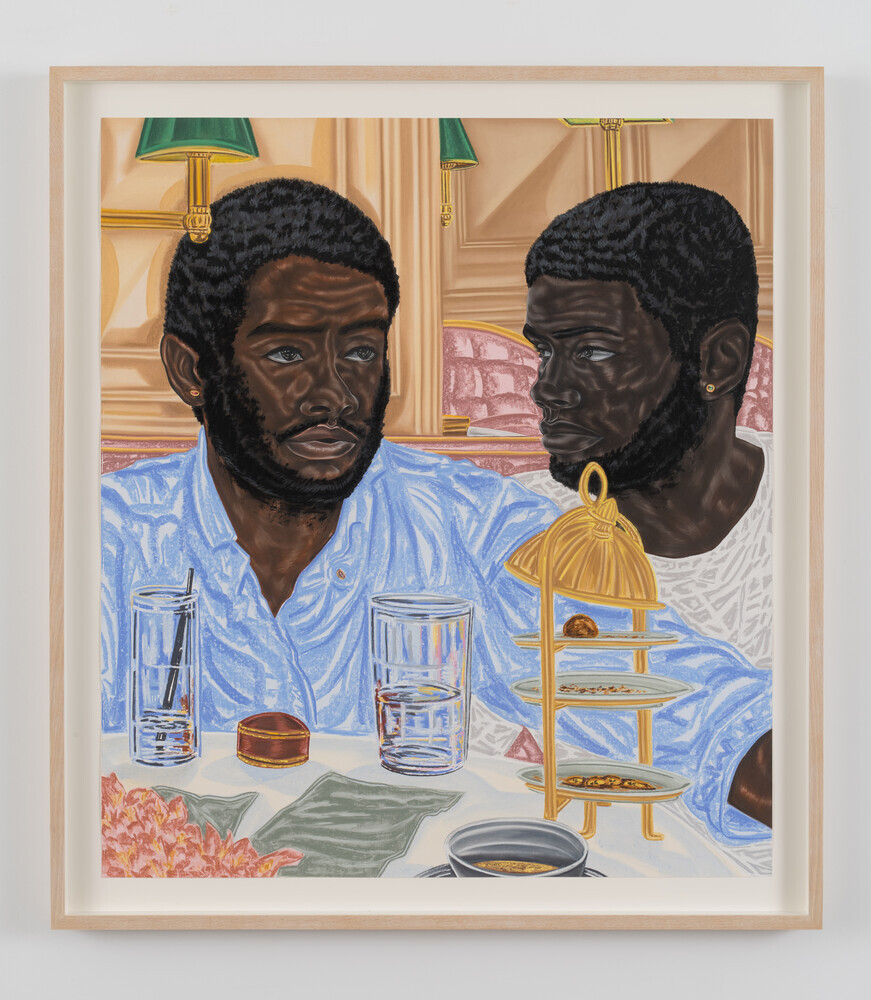
Toyin Ojih Odutola's The Proposal (2017) brings another register entirely: two men seated together in an intimate, meticulously rendered scene, their clothing, skin, furnishings and gestures described through pastel, charcoal and pencil. That range is important. Cafritz was committed to artists of African descent, but she did not collect a single aesthetic proposition. The cohesion came from the community of artists she chose to support, not from forcing their work into one visual style.
The exhibition's lead image, Philip Kwame Apagya's Come on Board (2000), is similarly revealing. Apagya photographs a woman against an elaborate painted aviation backdrop, collapsing the conventions of studio portraiture, aspiration, theatrical space and everyday self-fashioning. It is not difficult to see why the work fits an exhibition titled Dreams of This Future. Cafritz's collection consistently treated representation not as a completed political task but as a field in which artists could invent new images of themselves and others.
The final chapter of Cafritz's collection was planned rather than accidental. When she died in February 2018, the majority of her holdings went to two institutions whose missions reflected different parts of her life. More than 400 works entered the Studio Museum in Harlem. More than 250 went to the Duke Ellington School of the Arts. Together, the gifts totalled more than 650 works and were described by the Studio Museum as the largest gift of contemporary art by artists of African descent.
The division matters. The Studio Museum could place the works within a permanent collection devoted to artists of African descent, providing conservation, scholarship, loans and future exhibitions. Duke Ellington could use its share to build a research and display collection inside an educational institution Cafritz had helped create. The same private collection was therefore converted into two different kinds of public infrastructure.
For collectors thinking about legacy, that is more useful than the familiar question of whether a collection should stay together. Sometimes integrity is not achieved by preserving every object under one roof. It is achieved by placing works where they can continue the collector's underlying purpose. Cafritz's bequest aligned the objects with institutions whose work she already understood intimately.
There is another reason the exhibition deserves attention now. The art market is exceptionally good at rewriting uncertainty as inevitability. Once an artist is represented by a powerful gallery, acquired by a major museum or selling at high auction levels, early supporters are described as visionary. But serious collecting takes place before that retrospective certainty exists. It means making decisions when a career can still stall, when scholarship is incomplete and when there may be little secondary-market evidence to reassure the buyer.
Cafritz's record reminds collectors that patronage and connoisseurship do not need to be opposites. Supporting an artist early does not require lowering standards; it requires developing standards independently of consensus. The stronger question is not simply whether an artist will become famous. It is whether the work continues to deepen, whether the artist is building a language, and whether the collector is prepared to participate in a career rather than merely arrive after it has been validated.
That is where the fire becomes more than biography. It tested whether Cafritz's identity as a collector depended on the survival of a particular set of objects. Her response suggested that it did not. The collection could be destroyed and the collecting could continue because the real continuity was intellectual and social: the belief that artists needed sustained attention, that ownership could be a form of support, and that private resources could eventually be redirected into public culture.
Dreams of This Future does not restore the collection that burned in 2009. It shows something more difficult to replace and, in the long run, more consequential: the collecting philosophy that survived it.
Dreams of This Future: The Collection of Peggy Cooper Cafritz is on view at the Studio Museum in Harlem from 19 August 2026 to 28 February 2027.
From a £5 million Brueghel and three major Alice Neel sales to George Rickey, global modernism and a £675,000 Triceratops skull, Frieze Masters rewarded collectors who looked beyond categories.

Frieze London closed with sold-out emerging booths, meaningful institutional acquisitions and selective blue-chip buying. The real story was not a boom, but a market rewarding specificity.

Nearly 150 works from RM’s collection meet SFMOMA in a major exhibition of Korean modern and contemporary art. Its real lesson is how a private collection develops a coherent eye.