Gagosian’s ambitious London exhibition places René Magritte beside more than forty artists. For collectors, its real value lies in separating meaningful artistic inheritance from superficial resemblance — and in seeing why Magritte’s central problem, the unstable relationship between image and reality, feels newly urgent.
After Magritte: How One Artist’s Visual Language Became Contemporary Art’s Common Currency
Gagosian’s ambitious London exhibition places René Magritte beside more than forty artists. For collectors, its real value lies in separating meaningful artistic inheritance from superficial resemblance — and in seeing why Magritte’s central problem, the unstable relationship between image and reality, feels newly urgent.

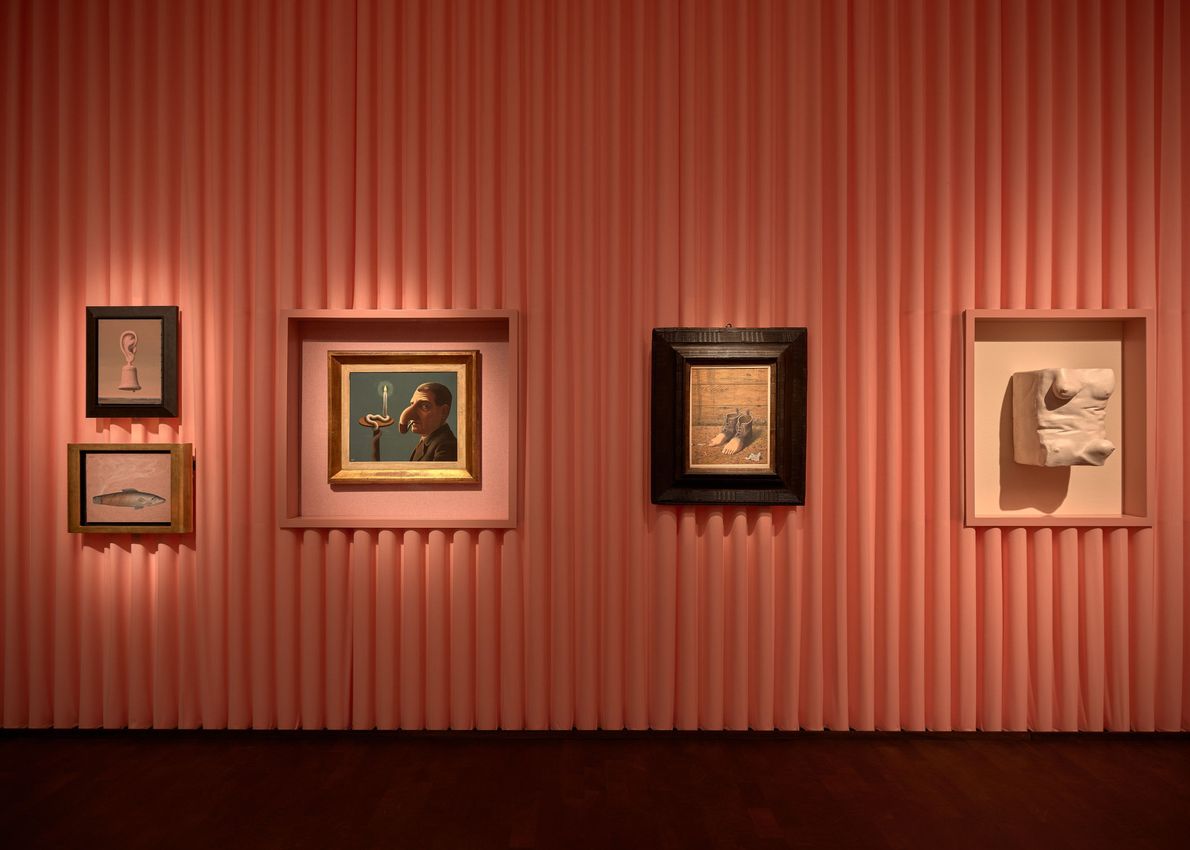
René Magritte’s afterlife is so extensive that it can be difficult to see it. Clouds, bowler hats, pipes, apples, curtained rooms, displaced objects and pictures that refuse to behave like pictures have become part of the ordinary visual grammar of contemporary culture. The achievement of This Is Still Not a Pipe: The Afterlife of Magritte, now on view at Gagosian’s Grosvenor Hill gallery in London through 12 December, is to put that familiarity under pressure.

Organised with the Fondation Magritte, the exhibition brings significant works by Magritte into direct conversation with more than forty artists of different generations. The premise could easily have produced a survey of quotations and visual jokes. Instead, the more useful question is what an artist inherits when Magritte’s devices are already embedded in visual culture. Influence here is not simply a matter of resemblance. It is a question of method: how images create doubt, how objects become unstable when context changes, and how language can make an apparently simple picture intellectually unreliable.
Before the icon came the problem

The historical Magrittes are crucial because they restore difficulty to images that reproduction has made deceptively familiar. Les Fleurs du voyage (1926), included in Magritte’s first one-person exhibition at Galerie Le Centaure in Brussels in 1927, belongs to the period in which he was still establishing the symbolic vocabulary that would later become instantly recognisable. L’Ombre céleste (1927) subsequently appeared in the Museum of Modern Art’s landmark 1936–37 exhibition Fantastic Art, Dada, Surrealism. Le Parfum de l’abîme (1928) was first owned by André Breton. These are not merely famous images; they are objects with histories that map Surrealism’s institutional and intellectual formation.
For collectors, that distinction matters. Magritte’s market is populated by works made across different periods, media and degrees of conceptual intensity. Familiar imagery alone is not a sufficient measure of importance. Date, exhibition history, provenance, relation to key motifs and the precision with which an image produces its conceptual disturbance all matter. The strongest works do not merely contain a pipe, cloud or apple; they make the viewer question what the image is doing.
The afterlife is not imitation

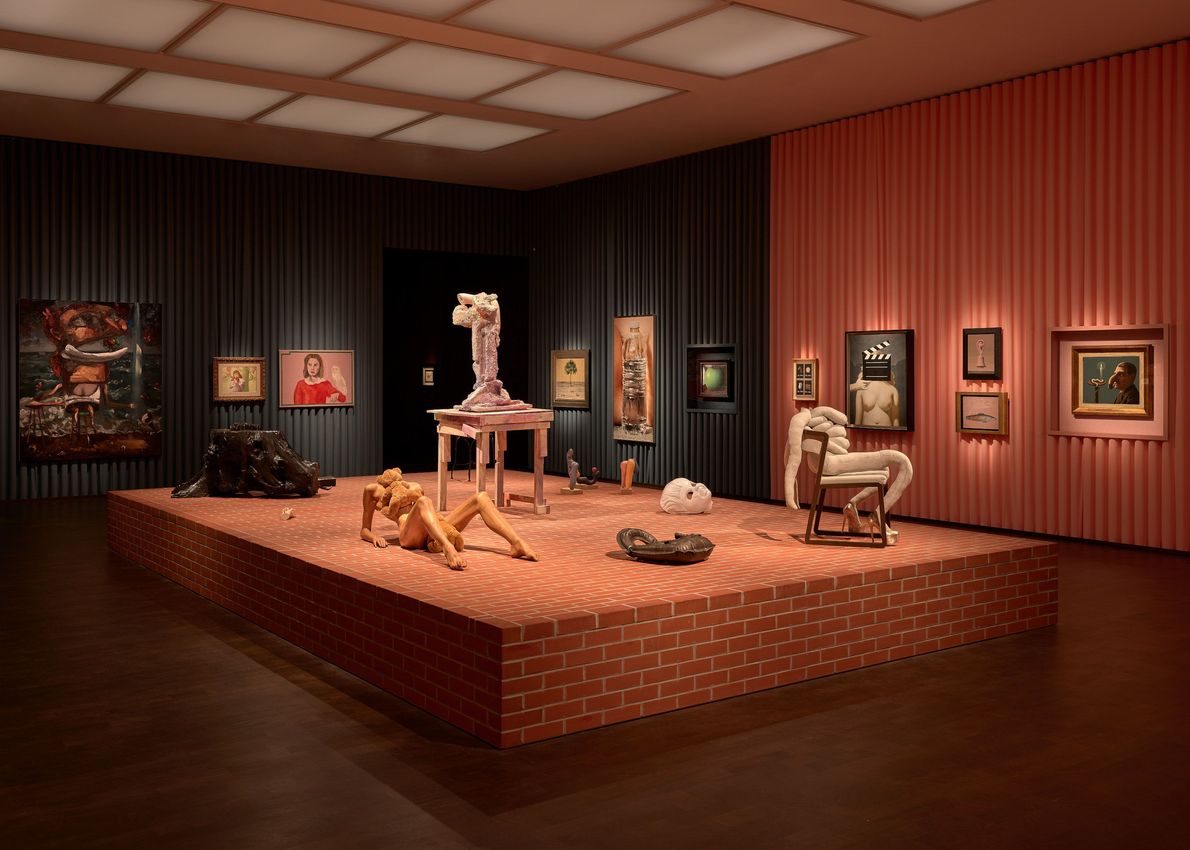
The contemporary half of the exhibition is strongest when it demonstrates that influence can operate without quotation. Artists including Vija Celmins, Robert Gober, Mona Hatoum, Sarah Lucas, Jeff Koons, Glenn Ligon, Dana Schutz, Alex Da Corte, Anna Weyant, Issy Wood and others enter a field Magritte helped establish: the ordinary object made psychologically or conceptually strange.
Vija Celmins’s Pink Pearl Eraser (1966–67), for example, enlarges an everyday object until its scale destabilises its identity. Dana Schutz’s new painting The Singer (2026) belongs to a very different painterly language, yet the exhibition encourages us to look for a related friction between recognition and impossibility. Harold Ancart’s Le Banquet (2026) similarly demonstrates that Magritte’s legacy need not arrive as a literal quotation of one of his motifs.
Installation as argument

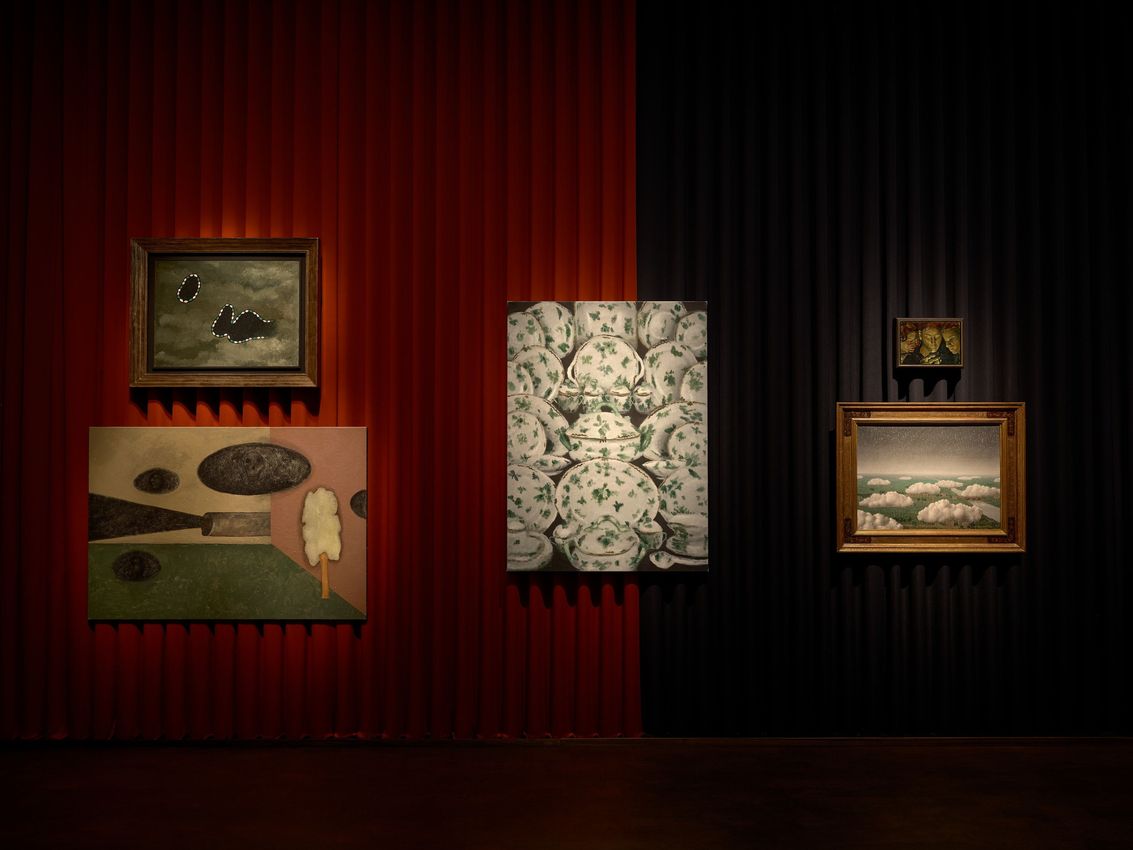
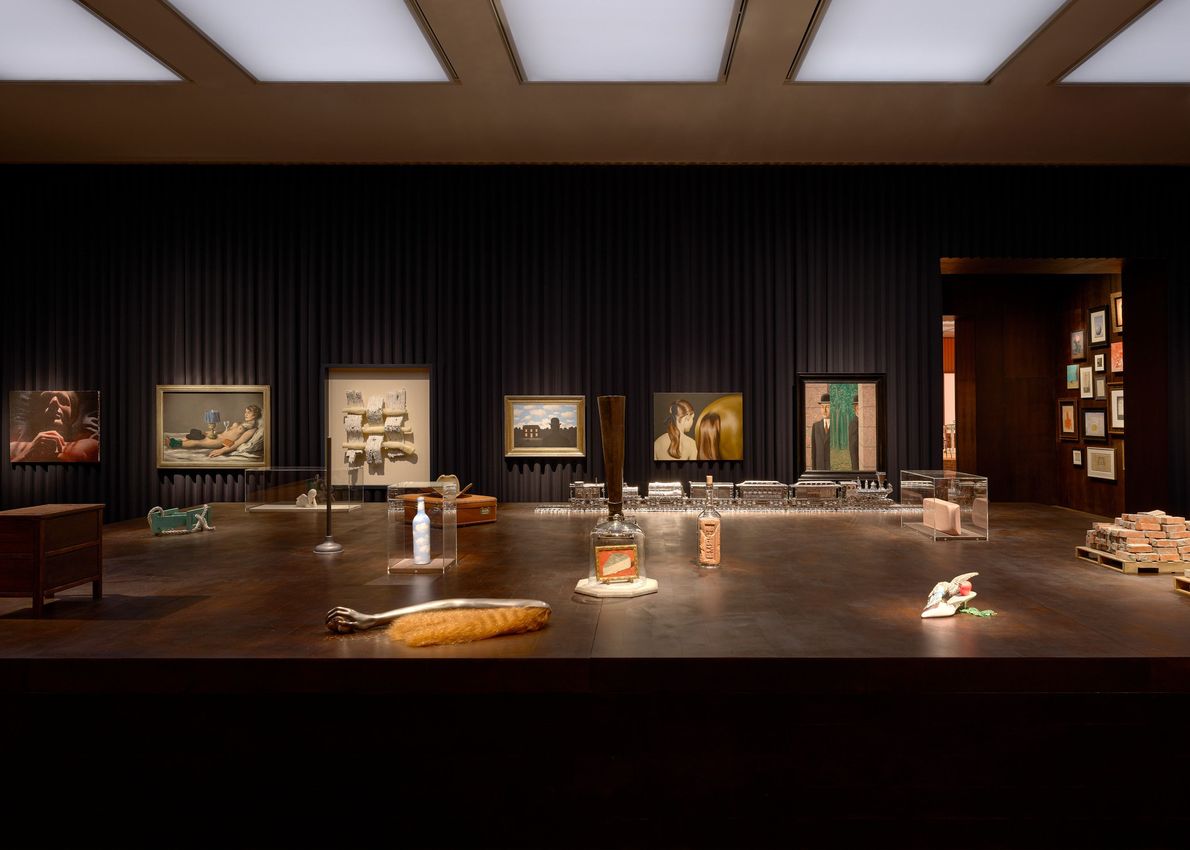
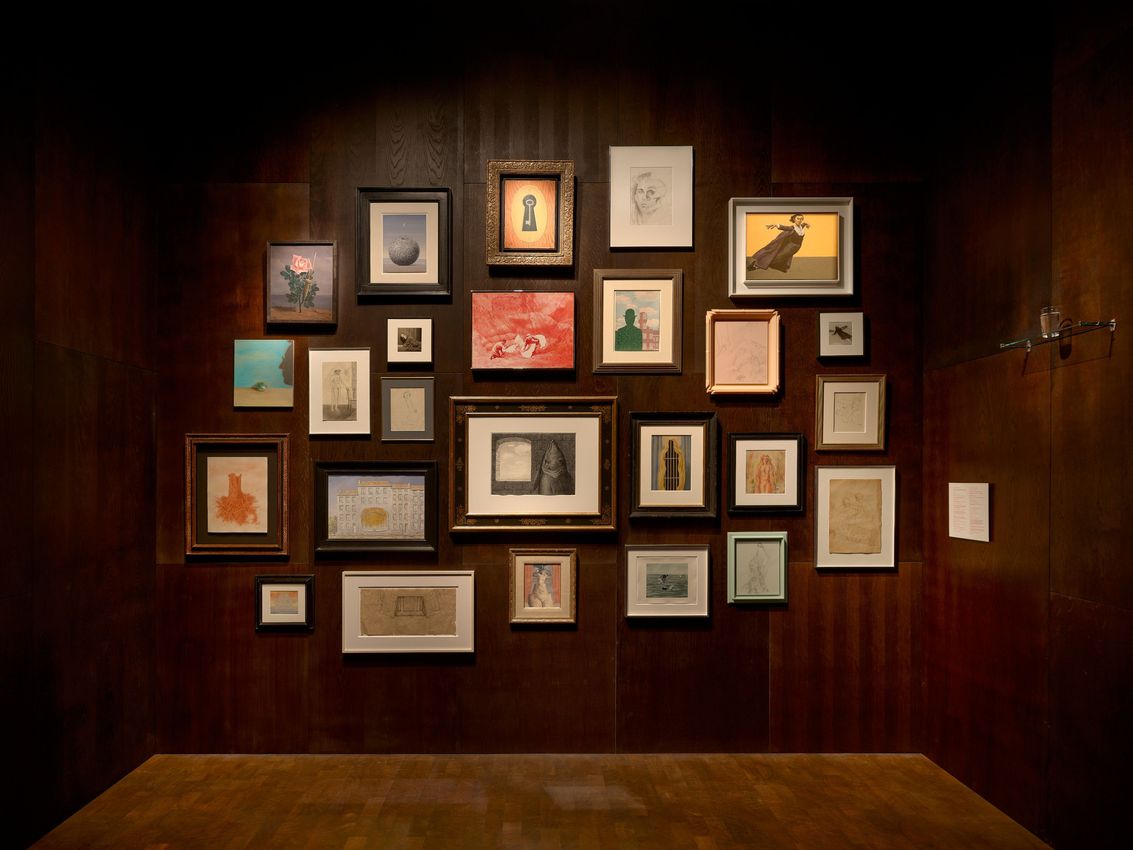
The installation is unusually important. Works are not presented in the neutral sequence of a conventional historical survey. Dark walls, theatrical groupings, platforms and dense constellations encourage visual rhymes and collisions. That approach risks spectacle, but it also makes a useful point: Magritte’s own pictures frequently depend upon staging. Rooms, windows, curtains, frames and carefully positioned objects operate like sets in which reality is rehearsed and then quietly sabotaged.
The exhibition therefore rewards looking across the room rather than only at individual labels. A collector can learn something from that. Art history is often encountered retrospectively as a sequence of names, but influence is less orderly. Artists absorb fragments, misunderstand predecessors productively, reject them, return to them and sometimes discover that an idea they considered contemporary has a much older genealogy.
What collectors should look for

For collectors considering Magritte himself, the exhibition is a reminder to distinguish iconography from significance. A recognisable motif may create immediate market legibility, but the quality of the individual work, its date, provenance, exhibition history and conceptual force remain decisive. For collectors of younger artists, the lesson runs in the opposite direction: recognisable influence should be the beginning of scrutiny, not the end of it.
The most interesting contemporary work in an historically framed exhibition is rarely the work that looks most like its predecessor. It is the work that has understood the predecessor’s problem and found another way to make it active. Magritte’s great subject was not the bowler hat, the apple or the pipe. It was the instability between an object, an image of an object, the word used to name it and the assumptions a viewer brings to all three.
A legacy hiding in plain sight

That is why Magritte remains unusually current. Contemporary life is saturated with images whose relationship to reality is increasingly uncertain. Magritte reached that instability through paint, language and deadpan visual logic rather than digital technology, but the intellectual problem feels newly urgent. A picture can be perfectly legible and still refuse to tell the truth.

This Is Still Not a Pipe: The Afterlife of Magritte is at Gagosian, 20 Grosvenor Hill, London, from 24 September to 12 December 2026.
Forget trying to see everything. Our collector’s guide to Frieze London and Frieze Masters identifies where discovery, scholarship and genuinely useful market intelligence are concentrated in 2026.
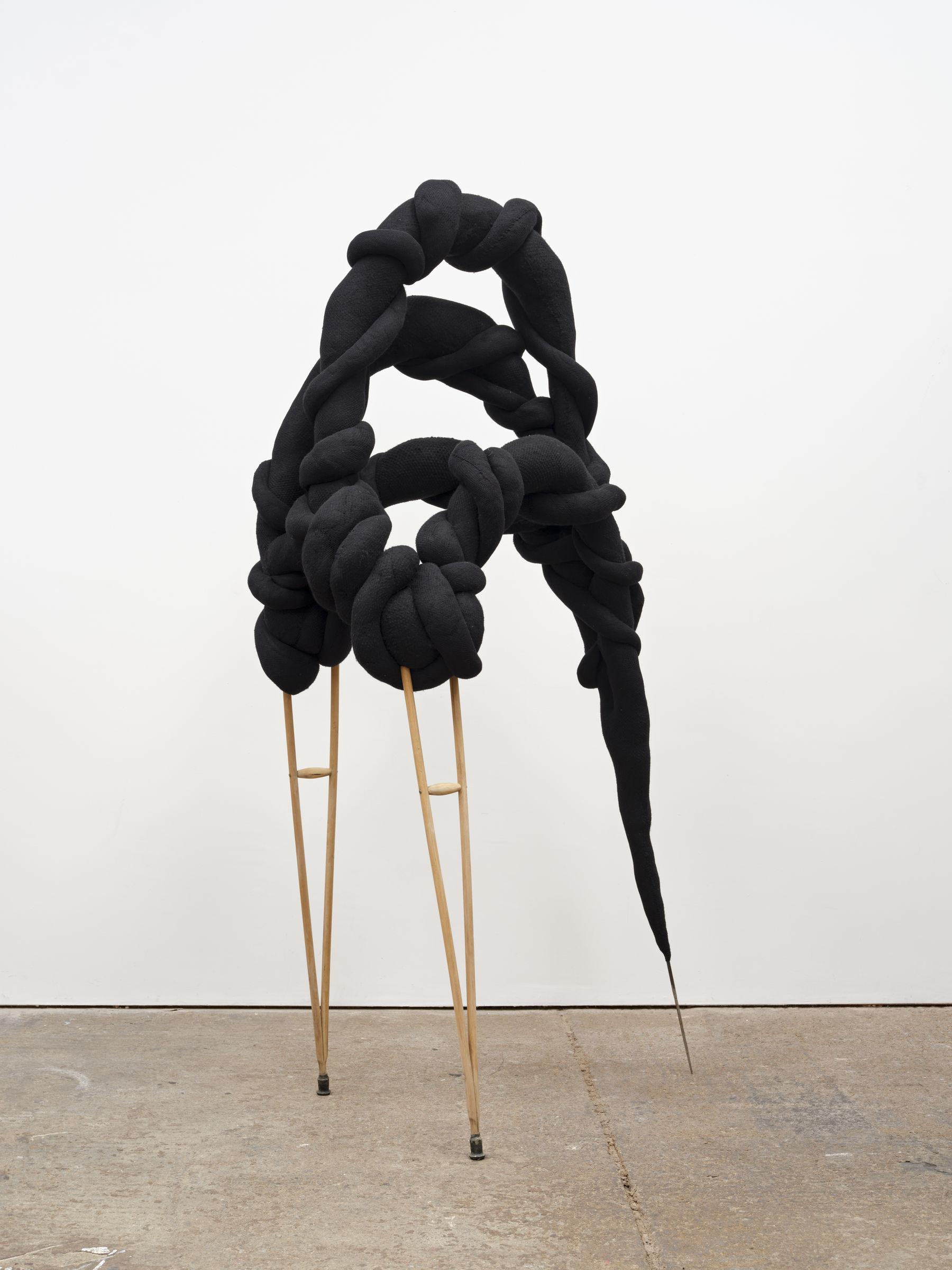
In I Tear Secrets From Your Yielding Flesh, Nicola Turner transforms wool, reclaimed horsehair and Hanover Square’s hidden histories into a persuasive, bodily sculpture installation.